

Web Hosting: What is it? Why is it that you need it? (And Why Do You Need It?)
Suppose that you wrote the best book ever written. If there isn’t a library or bookshelf to put it on, there’s no one who will ever find it. Web hosting is the bookshelf of your website.
Simply put, hosting is a place to live for your website. Simply put, it’s a place on a virtual computer that holds all of your website’s files and makes them accessible for anybody who visits your web site online.
If you’re building a website, you must store all your website files such as images, pages, videos, and code somewhere on the Internet for people to be able to visit the site 24/7. Well, somewhere is a web server, and the service that leases an area of the web server to you is called web hosting.
Your website can’t exist on the internet without web hosting. It is the key to all the websites you’ve ever visited, from a small personal blog to a large online store.
To put it simply: Domain is the address of your site (such as www.yoursite.com). Web Hosting = Websites’ real property.
Types of Web Hosting Explained
Not all hosting is the same. Rental of a room, an apartment or a mansion is quite similar to hosting, where different types are available for different needs and budgets. Let’s look at a breakdown of the most common ones.
1. Shared Hosting
This is the most preferred choice for novices. Shared hosting means your web page shares server resources (such as CPU, memory, and other resources) with hundreds of other websites that share the same server.
Cons: May lack some features, limited ability to customize, some are not as secure, require extra TLDs for additional features, no technical expertise necessary, and are very cheap
Pros: Pros are that it works well on a single server and when neighbours are light they’re OK. Cons: Cons are that they can slow down if the neighbours are heavy on the server, and there’s not much customisation.
Great for: personal blogs, small business websites, student projects, portfolio sites
Price range: $1 – $10 per month
2. VPS Hosting (Virtual Private Server)
VPS Hosting (Virtual Private Server) is the second option.The second option is VPS Hosting (Virtual Private Server).
VPS hosting is something like having a flat in a building. You still use the same physical machine as others, but you are allotted a space to use and have your own resources that no one else can access.
Cons: Little to no support, more complex configuration, potentially higher costs, requires advanced expertise, and may necessitate extra purchases.
Pros: Highly secure, more powerful than shared hosting, somewhat costly, and requires technical expertise to handle.
Perfect for: Growing sites, ecommerce stores, developers, businesses requiring additional power.
Price range: $10 – $80 per month
3. Dedicated Hosting
You have full access to the physical server. No sharing whatsoever. All the power, all the control.
Pros: Maximum performance, total control, enhanced security, handles huge traffic
Pros: Costly, advanced technical skills or server admin needed.
Suitable for: Large enterprises, high traffic sites, custom server setups, applications that need custom configurations.
Price range: $80 – $400+ per month
4. Cloud Hosting
Your website operates on a network of servers in the cloud, rather than one physical server. If one server is having problems, the other one will assume its role immediately.
Cons: latency issues may arise, support for some configurations is limited, some features might incur additional costs, pricing structure may seem a bit unfair to those who consume a large amount of data
Pros: It is relatively easy to use, but the pricing can be volatile, and it can be a bit more complicated to manage.
Best suited for: Startups, SaaS products, ecommerce stores that are expecting growth, businesses that require reliability.
Available for use anywhere in the world with internet access.Use anywhere around the world that you have internet access, and for $5 to 200+ per month.
5. WordPress Hosting
Hosting optimized to WordPress sites. It typically includes pre-installed WordPress, automatic updates and support teams that focus on WordPress.
Cons: Limited options for customization, can be expensive, may not offer all the features you need
Pros: It is only for WordPress sites, may be restrictive if you need to use other platforms.
Best suited for: Bloggers, Content Creators, Businesses that use WordPress sites
Price range: $3 – $50 per month
6. Reseller Hosting
You purchase hosting from the provider, and then sell it to your own customers as your brand. It’s a common trend among web designers and digital agencies.
Cons: White-labeling can be expensive, limited to two accounts, slows down performance, can be difficult to keep sensitive data separate, and is unsuitable for new hosting companies.
Pros: You have to take the responsibility of your client’s support needs, which are more complicated to manage.
Best suited for: Freelance Web Designers, Digital Agencies, Tech Entrepreneurs
Price range: $10 – $50 per month
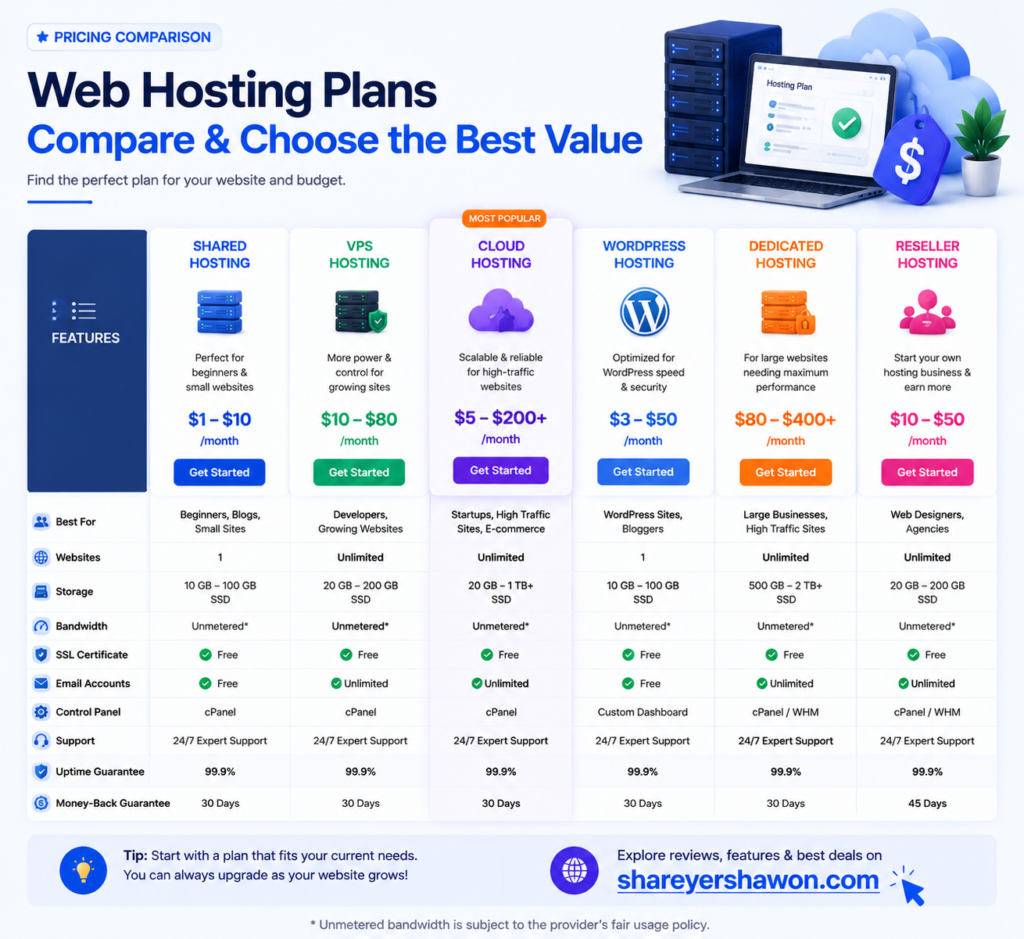
Quick Comparison: All Hosting Types at a Glance
Type | Best For | Price/mo | Pros | Cons |
|---|---|---|---|---|
Shared | Beginners, blogs, small sites | $1 – $10 | Cheap, easy to use, no tech skills needed | Slower, resources shared, limited control |
VPS | Growing sites, developers | $10 – $80 | More control, dedicated resources, scalable | Pricier, needs some technical knowledge |
Dedicated | Large businesses, high traffic | $80 – $400+ | Full control, maximum performance, secure | Expensive, requires server management skills |
Cloud | Startups, variable traffic sites | $5 – $200+ | Flexible scaling, high uptime, pay-as-you-go | Can get costly, complex billing |
WordPress | WordPress site owners | $3 – $50 | Optimised for WP, auto updates, easy setup | Limited to WordPress only |
Reseller | Web designers, agencies | $10 – $50 | Manage multiple clients, create own packages | You handle client support, more complex setup |
How to Choose the Right Hosting Plan
It isn’t only about cost savings when it comes to picking a hosting plan. It is based on a service that is not only quick and reliable but also secure and adaptable to the expansion of your website. This is my method for selecting the proper hosting plan for any project.
Step 1: Understand Your Traffic and Storage Needs
Initially, you must evaluate anticipated visitor volume, your content categories, and the overall magnitude of your site:
- Small websites: Ideal for portfolios or personal blogs with under 10 pages and 1,000–10,000 monthly visitors. Shared hosting typically suffices for these needs.
- Medium websites: Designed for expanding businesses or small stores with 10–50 pages and moderate media. VPS or Cloud hosting ensures the 10,000–50,000 monthly visitors enjoy consistent performance.
- Large websites: Suited for high-traffic e-commerce or media-heavy sites with over 50 pages and 50,000+ visitors. Dedicated servers or scalable Cloud solutions provide the most reliable infrastructure.
Pro tip: Always prepare for peak traffic spikes rather than just your averages. Underestimating these requirements can lead to sluggish page speeds or critical downtime when your audience needs you most.
Step 2: Check Performance and Uptime
You need to get your website up and running quickly. If your pages take too long to load or if you experience downtime, you will lose visitors, and negatively impact your search rankings.
- Check for 99.9% uptime or more.
- Look for genuine reviews on platforms like Trustpilot or HostingAdvice.
- Some providers, such as SiteGround and Cloudways, are renowned for their speedy loading times.
Pro tip: Don’t take marketing promises on their word; try out real speeds whenever you can.
Step 3: Prioritize Security
Security is not an option even small websites are targets. Check for a host that offers:
- HTTPS certificate of security.
- Backing up automatically (daily or weekly).
- Malware scanning and firewalls.
- DDoS Protection to block traffic attack.
Managed hosting plans typically take care of these automatically, which will conserve time and keep your website safer.
Step 4: Assess Support and Reliability
Even experienced website owners have issues. There are hours of stress that can be saved with good support:
- Make sure 24/7 live chat or phone support is available.
- Try them out first to see how fast they react.
- Look for tutorials, Knowledge Bases and staging environments.
Senior tip: Speedy, informed assistance is somewhat more valuable it can save you from small problems turning into big headaches.
Step 5: Set a Realistic Budget
Hosting prices vary:
- VPS Hosting: $5–$20 per month
- VPS or Cloud: $20–$60 per month
- Dedicated: $80–$300 per month
Tip: Watch renewal rates introductory offers typically increase after the first year. The annual plans are likely to be more affordable than the monthly plans.
Step 6: Plan for Growth
Your site will expand, and so should your hosting:
- Do you have the ability to easily move from Shared to VPS to Cloud?
- Do there exist staging environments to safely test changes?
- Do you have resource constraints that impact your site during its peak traffic periods?
Senior tips: Don’t switch hosts too many times — changing your host site is a process that takes time and can be risky.
Quick Guidelines
- Try to achieve 99.9% or more uptime.
- Always check real user reviews for performance and support.
- Test support responsiveness.
- Think about your future growth when deciding on storage, bandwidth and server type.
- Don’t pick the cheapest, it’s about reliability.
Recommended Hosting Companies
Choosing the right web hosting service is essential, as its performance, security, and scalability are closely linked to the success of your website. With the emphasis tied to performance, support, and scalability, here is a professional break down of a few of the most well-known global hosting providers:
Hostinger is proving to be one of the best choices for beginners and small business owners. Hostinger offers high-performance technology along with low prices, beginning at $2.69 to $2.99 per month for aggressive introductory rates. They also have LiteSpeed servers, NVMe SSD storage, and hPanel control panel which makes the website setup and management remarkably simple. Automated WordPress setups, AI-powered site builders and a simplified interface benefit beginners, and low-traffic blogs or small portfolios run well on their infrastructure.
SiteGround is designed for customers who prioritize speed, reliability, and excellent customer service. Google Cloud infrastructure guarantees highly redundant SSD storage, low latency routing and maximum uptime for SiteGround. They have a proprietary SiteGround Optimizer which optimizes WordPress performance by utilizing dynamic caching, Memcached integration, and optimizations on the front end of WordPress. SiteGround is perfect for small businesses, digital agencies and bloggers who want high performance and professional support over low prices.
If you’re a beginner WordPress user, you know BlueHost. Bluehost is recognized for its user-friendly experience, with automated WordPress site installation, free SSL certificates, and AI-based website creation. For shared hosting, you can expect to pay $1.99–$3.99 per month, while for VPS and dedicated hosting, you will have to pay more as your website grows. It is ideal for new businesses and novices who want to dive into website management without the hassle.
Cloudways offers a special cloud hosting platform that gives access to cloud servers from top hosting providers like Digital Ocean, AWS and Google Cloud. Excellent performance from the start with their Lightning stack pre-installed with NGINX, Apache, MariaDB, PHP-FPM and advanced caching. Cloudways is ideal for any developer, e-commerce platform, or digital agency that demands scalable cloud hosting services with minimal server management hassles. Pay as you go pricing: Flexible and starts at $11-$14 per month.
WP Engine is enterprise level Managed WordPress hosting. They provide an extremely fast loading time due to their EverCache technology, and all of their plans include advanced security, staging solutions and expert support. Startup plans start at $30 per month and are perfect for high-revenue businesses, professional publishers and agencies where uptime and performance are mission-critical.
A2 Hosting priorities are speed and developer flexibility – hence their name. A2 Hosting’s Turbo Servers, NVMe SSD storage and support for programming platforms such as Node.js, Python and Ruby makes it a great choice for performance enthusiasts and high-traffic applications. Starting from $2.99/month, shared plans offer essential features, but VPS and managed hosting delivers full control and improved performance.
DreamHost is ideal for independent creators, small businesses, and organizations that value open-source support and transparent pricing. Shared hosting is $2.89/month and Managed plans for WordPress on DreamPress are $14.99/month. DreamHost’s month-to-month pricing, automated backups, and custom control panel make it an ideal choice for novice users who want something flexible and easy to use.
Liquid Web is for enterprises who have premium Managed VPS, Cloud, and Bare-Metal hosting. They have an infrastructure geared towards mission critical applications that demand maximum up time, redundancy and high performance hardware. Pricing is enterprise focused and starts from $14.75 to $42.25 per month. It works best for large ecommerce stores, SaaS businesses, and businesses where reliability of the infrastructure is paramount.
There are strengths and weaknesses to each of these providers. Hostinger and Bluehost are great options for starters and small websites. If there is a need to provide further resources to the growing sites, then Cloudways or A2 Hosting can be provided with flexibility and scalability. Businesses with mission-critical demands or WordPress-related needs require enterprise level performance and support, which is provided by both WP Engine and SiteGround. If you are an enterprise organization or application that has demanding uptime needs, no one is as reliable or as robust as Liquid Web.
Note: Not only will price be a consideration, but performance, uptime, level of support, scalability, and long-term cost (renewal rates and additional features you may require) are important factors to look for in a host.
Frequently Asked Questions
Do you offer an easy way to upgrade or downgrade my hosting plan?
Yes, absolutely. Most hosting companies also allow you to upgrade your hosting plan as your website expands. Typically, you can switch from shared to VPS or from VPS to dedicated hosting with a couple of clicks in your dashboard. Some will even do the migration free of charge. The main thing is to select a provider to work with in the long term and ensure that the upgrades are smooth.
Is it essential to have a domain name before you secure web hosting?
Not necessarily. Most of the hosting companies offer a domain name as well as hosting services, and so you can register a new domain name and purchase hosting at the same time. But domain and hosting may also be of two different companies that are independent services. If you already own a domain name elsewhere, you just need to use a method called DNS settings to tell your new hosting company where your domain name is hosted.
Can business websites be hosted on shared web hosting?
Small businesses are safe and can get away with shared hosting. Security isn’t the primary concern, it’s performance. Your site is hosted on shared servers which sometimes make it slow. For sensitive data and payment systems (such as an ecommerce site), you might want to use a VPS or managed WordPress plan with additional isolation and security measures.
What is my bandwidth and storage requirement?
For most beginners, the storage and bandwidth of entry level plans is more than sufficient. Any blog or small business website will not even consume 5GB of storage space or a lot of bandwidth. As a rule of thumb:
Personal blog or portfolio: Storage space and bandwidth are sufficient, 5 to 10GB and unmetered.
Small online store: 10 – 50GB and bandwidth to handle several thousand monthly visitors
Media intensive site or large ecommerce: Opt for unlimited or high capacity storage, or VPS or cloud.
Beware of providers with ‘unlimited’ storage, check the fine print. There is typically some sort of a fair-use policy.
Conclusion and Recommendations
There are three important factors that you need to consider when selecting the right web hosting plan for your website: your current website needs, expected growth and budget. This is a practical guide to help you make a decision:
Best Hosting for Beginners
For the newbies, shared hosting is typically enough. Namecheap, Bluehost, and HostGator are providers that have entry-level plans of less than $3 per month. They’re easy to follow and have 1-click WordPress installations, as well as all the tools you need to get your first site up and running without any technical hassles.
Best hosting solutions for expanding businesses.
Once you’ve gained more visitors to your site, it’s time you switch to VPS or cloud hosting. Cloud-based (Cloudways) and VPS (A2 Hosting) are the better performing platforms, providing more control and the ability to expand resources as your audience expands. Of course, at this point you are looking at spending approximately $10-$50 per month, depending on traffic and resource needs.
Best hosting for high traffic websites is a website that has a high traffic.
If you’re generating high traffic or high revenue, then you should think of managed WordPress hosting or dedicated servers. High-traffic WordPress sites such as WP Engine and Kinsta offer outstanding speed, strong security, and personal support. If you’re working on a non-WordPress site or an enterprise-level application, you’ll need a dedicated server or managed cloud hosting solution to guarantee high levels of reliability, performance and uptime.

333985
June 28, 2026 at 2:27 pmyahoo,im go