
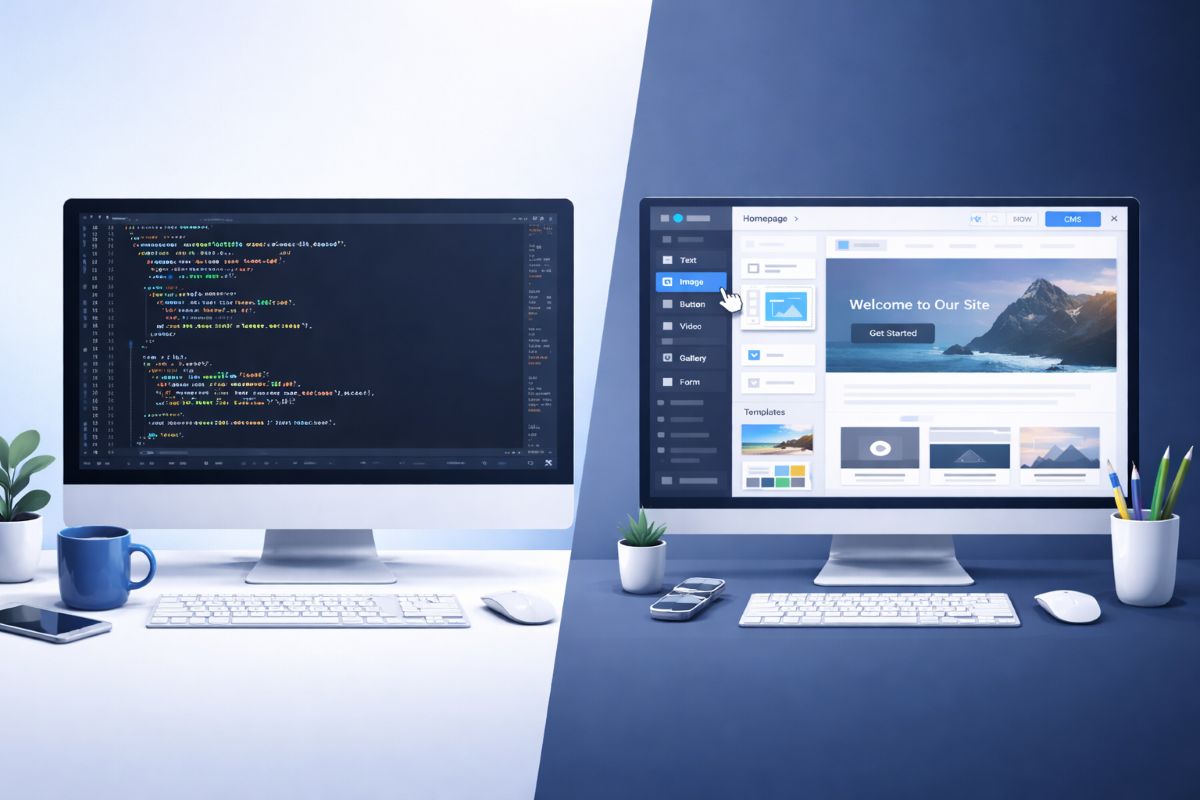
You’re ready to build your business’s online presence. You’ve got a budget, a vision, and a deadline. But then the question hits you: should you invest in a fully custom-coded website, or go with a CMS platform like WordPress or Shopify?
It’s one of the most consequential decisions you’ll make for your digital presence — and the wrong choice can cost you thousands of dollars and months of frustration. I’ve built websites for businesses of all sizes, from solo consultants to multi-location retail brands, and the answer is almost never black and white.
Let me break it down clearly, so you can make the right call for your business today.
What Is a Custom Coded Website?
A custom-coded website is built entirely from scratch by a developer — no templates, no pre-built frameworks, no drag-and-drop editors. Every line of HTML, CSS, JavaScript, and back-end code is written specifically for your business’s unique requirements.
Think of it like commissioning a bespoke suit. It fits perfectly, it reflects your brand down to the last detail, and it’s built to do exactly what you need — nothing more, nothing less.
Custom websites are the right choice when you have complex functionality requirements that off-the-shelf tools simply can’t handle — for example, a proprietary booking engine, a custom inventory management system integrated with your internal software, or a highly specialized user experience that no CMS theme can replicate.
The trade-off? Time and money. A professional custom website can take three to six months to develop and can easily run from $5,000 on the low end to $50,000 or more for complex builds. Ongoing maintenance also requires a developer, which means you’re dependent on technical resources for even minor updates.

What Is a CMS Website?
A CMS or Content Management System is a software platform that lets you build, manage, and update a website without needing to write code. The most popular CMS platforms include WordPress, which powers over 43% of all websites on the internet, and Shopify, which has become the go-to solution for e-commerce businesses of all sizes.
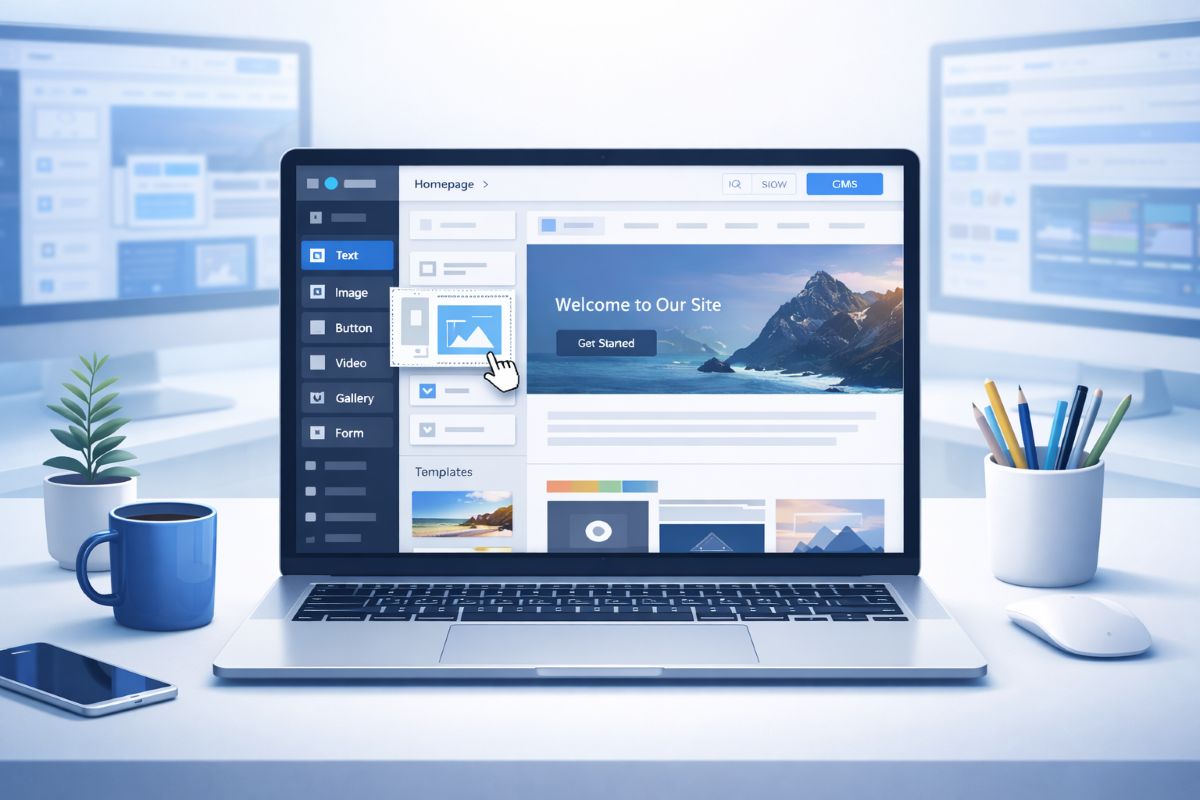
With a CMS, you choose from thousands of professionally designed themes, install plugins to add functionality (contact forms, SEO tools, booking systems, payment gateways), and manage your content through a simple, user-friendly dashboard.
For most small businesses, a CMS is the practical starting point. You can get a professional, functional website live in two to eight weeks, at a fraction of the cost of a custom build. And critically, you don’t need a developer on call just to change your homepage copy or update your pricing page.
Custom Website vs CMS Website: Side-by-Side Comparison
Here’s how the two options compare across the factors that matter most to small business owners:
Factor | Custom Website | CMS Website | Winner | Small Biz Pick | Notes |
Cost | $5,000–$50,000+ | $500–$5,000 | CMS | CMS | Custom = higher upfront |
Flexibility | Unlimited | Plugin-limited | Custom | Depends | Custom wins for unique needs |
Scalability | Excellent | Good | Custom | CMS | CMS scales well for most SMBs |
SEO Control | Full control | Strong plugins | Custom | CMS | Yoast/RankMath covers most needs |
Security | Hardened | Plugin risks | Custom | Tie | CMS is safe if maintained |
Maintenance | Dev required | DIY-friendly | CMS | CMS | CMS wins for non-tech owners |
Time to Launch | 3–6+ months | 2–8 weeks | CMS | CMS | Speed matters for startups |
A Closer Look at the Key Factors
Cost
Cost is usually the deciding factor for startups and small businesses. A well-built WordPress or Shopify site typically runs $500–$5,000 for design and setup (plus $20–$80/month in hosting and tools). A custom-coded site requires a significantly larger upfront investment, and every future update requires paid developer time. Unless you have a specific technical need that a CMS cannot meet, the cost advantage of CMS platforms is difficult to ignore at the early stages of a business.
Flexibility
This is where custom wins, hands down. A custom website can do anything you can imagine and code. A CMS, by contrast, operates within the boundaries of its plugin ecosystem and theme structure. For 90% of small businesses, those boundaries are more than sufficient — but for the remaining 10% with truly unique requirements, a CMS can become a limiting factor as the business grows.
Scalability
Both options can scale, but in different ways. WordPress with the right hosting infrastructure can handle millions of monthly visitors. Shopify is specifically engineered to scale with your store as order volumes increase. Custom websites scale based on the architectural decisions made at build time, which means poor early planning can lead to expensive rebuilds later. For most growing small businesses, a well-configured CMS is the more practical and cost-effective path to scale.
SEO
Here’s a common misconception: custom websites are not automatically better for SEO than CMS websites. WordPress, in particular, is among the most SEO-friendly platforms available. With plugins like Yoast SEO or Rank Math, you have full control over meta titles, descriptions, schema markup, XML sitemaps, canonical tags, and page speed optimization. Where custom websites do have an edge is in technical SEO — developers can build leaner, faster-loading pages without the overhead of a CMS. But for most small businesses, CMS SEO capabilities are more than sufficient.
Security
Custom websites can be made extremely secure because there’s no public codebase for hackers to probe. However, WordPress sites are frequently targeted because of poorly maintained plugins and themes. The key word there is ‘poorly maintained.’ A properly secured and regularly updated WordPress installation is perfectly safe for business use. If you go the CMS route, commit to regular updates, use a reputable security plugin, and invest in managed hosting.
Maintenance
A CMS is built to be managed by non-technical users. You can update content, add pages, change images, and publish blog posts without touching a line of code. With a custom website, virtually every change requires developer involvement. For small business owners who want independence and control, this makes CMS platforms a clear winner in day-to-day usability.
When Should a Small Business Choose a Custom Website?
Consider a custom build if any of the following apply:
- Your business requires functionality that no existing plugin or platform can deliver
- You operate in a highly regulated industry with specific compliance or security requirements
- Your site will serve as a core revenue-generating platform with complex logic (e.g., a marketplace, SaaS dashboard, or advanced booking engine)
- You have a substantial budget and a dedicated in-house developer or long-term agency partnership
- Your brand identity demands a completely unique digital experience that templates cannot achieve
When Should a Small Business Choose a CMS Website?
Choose a CMS platform if:
- You’re launching a new business and need to get online quickly and affordably
- Your website serves standard business purposes showcasing services, capturing leads, running an online store
- You want to manage and update your own content without relying on a developer
- You’re working with a limited budget and need maximum value per dollar spent
- You want access to a large ecosystem of plugins, themes, and community support
My Recommendation for Small Businesses
After years of building websites for small businesses, startups, and entrepreneurs, here’s my honest recommendation: start with a CMS.
For the vast majority of small businesses, a well-designed WordPress or Shopify website built with the right theme, properly configured plugins, and solid hosting will outperform a hastily built custom site every single time. It’ll get you online faster, cost less, and give you the flexibility to manage your own content from day one.
The businesses that genuinely benefit from custom development are those with specific, complex technical requirements that a CMS platform cannot meet. And even then, many will start with a CMS and move to a custom solution once they’ve validated their business model and have the revenue to invest.
If you’re a startup or small business owner, don’t let anyone convince you that a CMS website is ‘less professional’ than a custom build. What makes a website professional is the quality of the strategy, design, and content behind it not the technology stack underneath it.
That said, whichever route you choose, make sure you’re working with someone who understands both the technical requirements and your business goals. A cheap website built without strategy is expensive regardless of the platform.

足球生活
March 7, 2026 at 2:21 am挺不错的样子嘛!